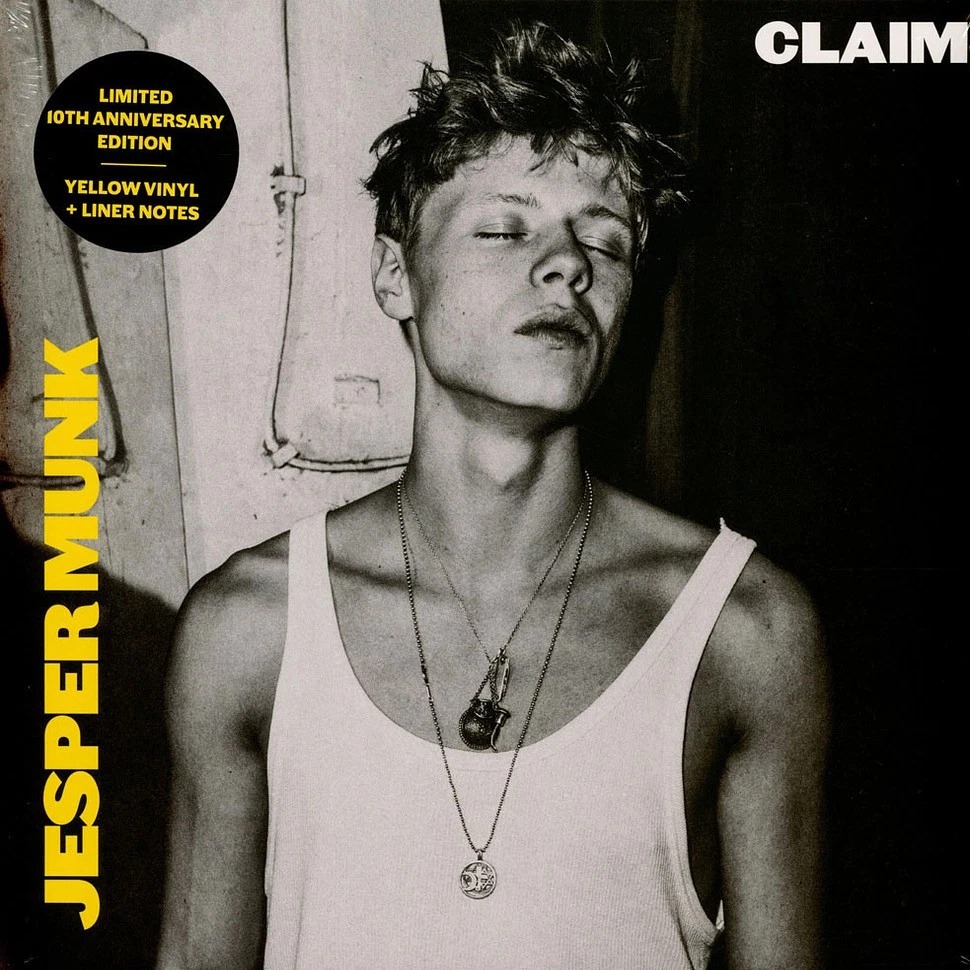
“MAKING OF CLAIM
WRITTEN BY JESPER MUNK
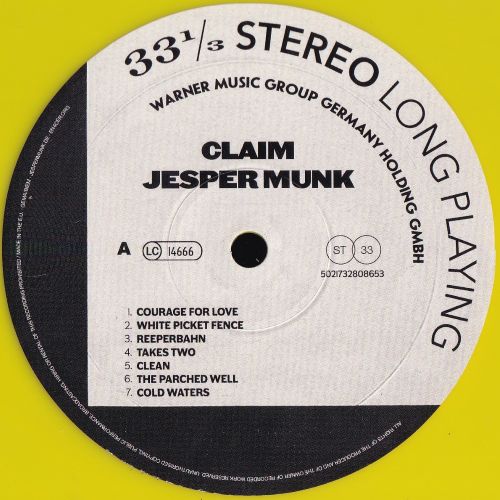
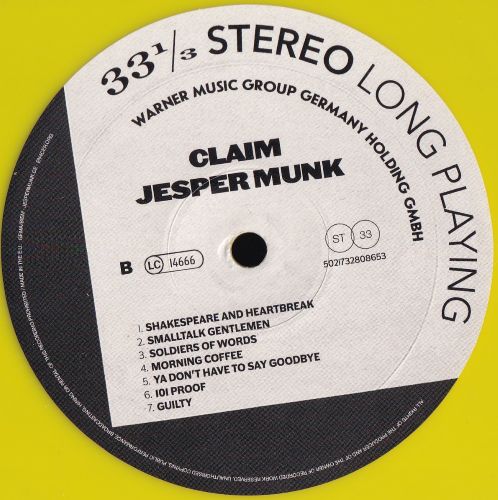
CLAIM: I remember the writing and recording process of CLAIM feeling very differently to the making of the first album. The project was getting a lot of attention after the debut and it wasn’t really surprising that that would come with expectations. Nevertheless it really took me by surprise how blurred ones vision would get with this many eyes watching. The first writing sessions were in our rehearsal room with my dear friends Clemens Finck von Finckenstein, Mateo Navarro, Louis von Stebut, Sassehbaloh Söllner and sometimes with my dad, Rainer Germann, who had musically influenced my childhood and teenage years and later had managed me in the early years of my musical career right to this point. Later we took some of these tracks and recorded them at Bonifaz Prexel’s studio close to Munich in a little province called Niederding.
Sophie Rami started to be my manager at this time, which was to this day is one of the best things that has ever happened to me. I remember visiting her office well. This grounded empathy, sharp, rational and no-bullshit business sense, while still treating every human in her surrounding with the same amount of understanding and professionalism was unmatched. She was truly inspiring to me as a human being in this industry. An industry that was going through so many changes at this time, most of them to the worst. Sophie was the one that suggested to go to LA, meet Mocky, write and record with him. I didn’t know Mocky, but right after listening to ‘Game For Fools’ by Jamie Lidell, which he had produced, I decided to go. Only a week before leaving for our session, did I realise that he had also written and produced for Feist. Peaches and Chilli Gonzales, who had released a lot of songs that deeply moved me over the years.
LAX: Landing in LAX, the airport connecting the world to the city of (broken) dreams, felt like stepping into a movie. I had brought a borrowed guitar and a backpack and was supposed to meet Mocky for an early dinner around five. I really felt like I had no idea about the complexities of songwriting, all I had were my little feelings and notions of what not to do. So I met Mocky at a burger joint and after a warm embrace and a burger, he took me through a beautiful week of co-writing at the songs I had prepared. We mostly wrote at his place, which made me feel comfortable and less nervous about the upcoming recordings. We’d start with coffee and a little jam, ending most sessions right before dinner with his family. From time to time Mocky would invite Nick Rosen (bass) or Joey Dosik (keys) over for a musical meet and greet, they all seemed like a family and they all seemed magical to me. I sometimes felt anxious about not knowing enough, but even my ignorance was turned into some kind of special thing in the presence of these people. The recordings were a great mixture between good planning, retaining overview, intuition and always staying open to take vastly different routes towards the song. After all the brilliant things I saw and I heard him do in this time. Dominic “Mocky” Salole, taught me one of the most precious lessons in music and life: Community is everything. Mocky would call the humans he made music with his “magical musical family and to this day I try seeing everyone I share music with like that.
FJS: I came back to Munich to have some sessions with a teenage hero of mine, Sepalot (aka Sebastian Weiß). He was the producer of a local rap group called Blumentopf. These sessions with Sebastian went so I smoothly, which was great because it was the first time I didn’t start a song with a guitar, but with sketches of another person, produced in a more modern way. This was not my comfort zone, but he very quickly made the environment so hospitable, that I just wanted to spend time with him and the music. Sepalot seemed to have a never ending pool of ideas. Whenever I started feeling like that was not really where I wanted to go, it seemed like he immediately had valid solutions to go somewhere different and make that fun and fluid.
JFK: The New York experience was so different to LA it was almost comical. We went there as the full band at the time: Clemens, my dad and me. Arriving in JFK makes you feel like you’re some kind of criminal for trying to enter the US, no matter the reason or intent – all this while you’re butt is still waking up in the two hour long cue at immigration. In retrospective this welcome might have helped with the recordings. My dad had shown me a lot of Jon Spencer and the Blues Explosion and at some point after the release of the first album he suggested going to NY to record with him. How crazy would that be? We had a little apartment in what seemed like a social housing block close to the east village.
NY Hed Studios was a 10 minute walk, so going to the studio made me feel like going to work in New York, which in itself felt super cool for 22yr old me. It’s fun remembering how grand everything felt, intimidating and exciting. Matt Verta-Ray, who played in Heavy Trash with Jon, was going to be the engineer. We recorded straight onto reel. The studio was small and had all these amazing artefacts laying around. We set the whole thing up as you’d set up a rehearsal room with monitors instead of headphones and in a triangle formation looking at each other. Jon had a dark and stoic aura, was very calm and mostly said something, when it served the song. I loved that. We got along well with very few words. Most lessons here were in how to conduct yourself in the studio, how to detect imbalance in a track and after a few days amidst all these ancient WW2 amplifiers, the big two inch tapes we were recording on and the relentless protocolling of every step, I thought I rightfully pinned them down as purists. Of course they weren’t. At one of our lunches Jon looks over and tells me that there is no wrong way of recording, there is just wrong for you. Digital will most likely involve a screen, so if you have a hard time concentrating on the music when there’s a screen around, maybe analogue is the way for you. I was so distracted by what needed to do, that I didn’t consciously realise that there was no screen. I think it’s mainly because of Jon, that I try to track the band on cassette, then digitise and go on mixing on the computer.
The rest of the album was finalised where we started. At Bonifatz Prexels studio in Niederding close to home. I can finally say that I love the album for what it is. Over the last years I’ve been very critical of my writing and singing on parts of this record, but what stands out for me today is that I’ve probably learned more about the pillars of writing and producing in the making of this album than any other that I’ve made to date. It was great fun having another listen and to try and recall the making of CLAIM. Thanks for listening.
I hope you’ll have a beautiful day, Jesper”
“Thanks to everyone who was involved in creating this record and to every artist I had the honor of spending time and ideas with. You all taught me a lot. And of course you, dear listener.”








![Samantha Fish & Jesse Dayton – Deathwish Blues [Purple Smoke] (LP, US)](../wp-content/uploads/2023/02/SFJD-copy-300x300.jpg)
![The Sadies – Colder Streams [Black] (LP, US)](../wp-content/uploads/2022/06/scsb-300x300.jpg)

![R.L. Burnside – Mr Wizard (25th Anniversary Edition) [Clear Vinyl] (LP, US)](../wp-content/uploads/2022/07/c-copy-300x300.jpg)
![The Bobby Lees – Skin Suit [Blue] (LP, US)](../wp-content/uploads/2022/04/cover-300x300.jpg)


![The Muffs [2015] (CD, US)](../wp-content/uploads/2015/11/muffs-300x300.jpg)
![Perrosky - Tostado [2015] (CD, JAPAN)](../wp-content/uploads/2015/06/perrc-300x261.jpg)


![Diabologum – #3 [2015] (2xLP, FRANCE)](../wp-content/uploads/2015/07/IMG_0119-300x251.jpg)
