SONIC SISTER LIVE
10-14-87
Cabaret Metro
Chicago
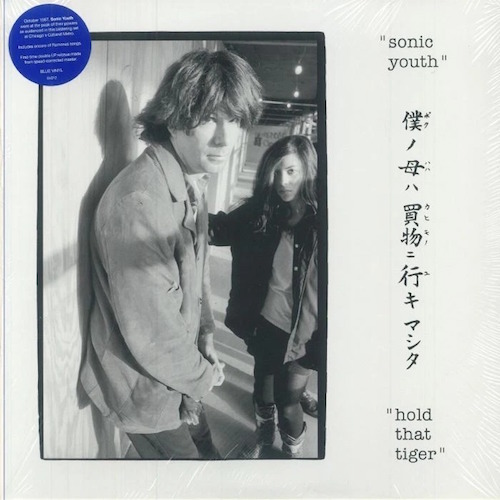
Sonic Youth decided to start an in-house label of sorts in 90 which we’d call Goofin’, taking the piss, as it were, from us having recently signed to corporate demon god label Geffen. Our rock scribe archivist pal/maniac Byron Coley jumped in to help us facilitate such a thing as he had already many years of releasing weirdo under-the-mainstream-radar recordings and knew where to get vinyl manufactured without too many questions being asked. The first Goofin’ foray was the 4 Tunna Brix 12″ EP, a 1988 John Peel BBC radio session of SY covering songs by The Fall, with assistance from Epic Soundtracks, our drummer songwriter pal from Swell Maps. For our second Goofin’ release in 91, we decided to unleash the live tape we had from Cabaret Metro from Chicago 87 as recorded by a young gent named Aadam Jacobs. Aadam was someone who’d always show up at our Chicago gigs, tape deck at the ready. He did this for lotsa bands in our micro-community of experimental post punk roustabouts amassing a goldmine of documentation. Steve Albini was invited to introduce us that night. He had been banned from Cabaret Metro for saying something publicly scabrous about the proprietor(s) and so we figured if we personally asked for him to be on stage with us, they’d have to let him in – and it worked. We met Steve when Big Black first played NYC a couple of years earlier and he then put on our second ever Chicago gig at Smart Bar in 85. That’s probably when Aadam first saw us, though I’m not sure either Aadam or Steve were at our very first Chicago gig at Club Exit when Bob Bert was drumming back in 82. If memory serves, there were hardly ten people in the room at that gig, one of them being the singer from Chicago punk legends, The Effigies (he split before we played). Albini refers to us in his stage intro as Richard Kern and the Black Snakes, the Kings of Cough Syrup. He was beside himself after hosting the Black Snakes when they blew through Chicago some days prior and all they did was lie around and drink cough syrup. Glug glug zzzz. Aadam’s live recording was a bit too long for the time limitation of an LP so it was decided to slightly speed the tape up to fit. I haven’t any recollection of agreeing to this but maybe it made it sound hotter and maybe it helped with the key-challenged vocals (I speak for myself here) which were fairly constant during this era. I asked J.D. King, my old friend from The Coachmen, the late 70s NYC band I played guitar in, who was a graphic artist, to create a Goofin’ logo, which was what we used for the labels. Hold That Tiger as a title was shot straight from Byron Coley’s brain, I’m guessing. The front photo of Bob Bert and Julie Cafritz from their mid-80s Pussy Galore glory days was snapped by Pat Blashill, a compatriot lensman coming out of the Austin/NYC/Hoboken noise rock axis and I thought it was perfectly evocative and would be badass and funny to use as an album cover. The back photo is a shot sent to me by some cat named John Lee from when we played the New Music America Festival in Houston in 86. I thought it’d look great full bleed – this “live” image where the band is basically kneeling around a set list on stage. We had just driven our van all day to get to Houston and unloaded our gear and were told that it was “time to play!” – but Byron decided to make tiny multiples of the image making it ridiculously obscure – which I’m still pissed off about. We’ve since made up (kind of). This was the Sister tour and we were playing an encore of four Ramones songs which in some ways was like the perfect pudding after a hearty meal. I looked forward to it with sonic salivation each night. 1987 – we had no money and our guitars and amps were constantly falling apart and the van kept breaking down. And we loved every freakin second.
Thurston Moore, London 2024
Hold That Tiger is a special album for many longtime Sonic Youth fans. For one thing, it was one of the few pieces of live SY material that people outside the taper community could get ahold of for many years. Before ready access to “content” or an endless stream of algorithmic You Might Also Like, one live album could be revelatory for a fan. Hold That Tiger delivers. From the start, the opening beat of “Schizophrenia” is revealed to be more motorik than the studio version lets on, with subtle epiphanies on through to the closing Ramones mini-set where the band who are maybe assumed to be unflinchingly dark/serious/No Wave joyfully rip through punk liturgy.
With this album and a few other clues (Live at the Continental Club, the Dirty Boots 12″) it turns out that Sonic Youth more than most artists are presenting a site-specific performance every night. It’s not like trying to cram a touring Broadway show into a regional theatre. The performers don’t just hit their marks and recite their lines, with better or worse surroundings. A Sonic Youth show is anything but a rote repetition of the songs from the album, it’s more of a space ritual where the audience, the local friends, the experiences of the day, records and books bought, foods enjoyed, all join the band at the altar to weave together as much transcendence as possible… in a casual way.
At this point, even a smallish band will often travel with multitrack recording capabilities – recording every input from the stage and maybe some room microphones as well. In 1987, this would have required a Rolling Stones level of mobile recording truck. So tapes from this time generally fall into two categories: board or audience. A board tape takes a feed directly from the mixing board, often picked off from the same signal that is feeding the PA system. The inputs from the stage sound direct or “pure” like a studio recording. But there are several downsides. For a rock band, the balance between instruments can be goofy: loud guitar amps on stage for example might mean there isn’t much need to put guitar in the PA. So, if you listen back to a tape of what was being sent to the PA, you’re going to not hear much guitar. Additionally, a board tape can just feel lifeless… if the idea is to conduct a ritual in a room with a crowd, and you don’t capture the room or the crowd, playback of the music can lack some mojo.
An audience tape is a recording made with microphones in the room where the performance happens. Basically, it’s the opposite in the sense that it sacrifices clarity for balance and mojo. At worst, microphones at the back of a long and reverberant room can produce a tape that is murky and unintelligible.
Hold That Tiger is an audience tape with a twist. The Metro has a rare qual- ity for rock clubs: it is wider than it is deep. The stage itself is 30 feet wide, and the balcony is only 25 feet from the lip of the stage. By setting a pair of microphones at the edge of the balcony, Aadam Jacobs was able to capture the mythical sweet spot, a position you could never normally record from because mics that close would be jostled by the crowd, have acoustic shadows thrown over them by tall people walking by, and capture a disproportionate amount of crowd chatter.
When using a pair of microphones like this, there is the question of how to orient them to one another to make a compelling stereo recording. To me, this sounds like a spaced pair of microphones. For this technique, people often put the mics about 1 human head away from each other, like ears. The spaced pair technique can create a wide and complex stereo field. It has the disadvantage of a less-defined center. In this case, the complexity of the stereo field lets the music live in a sort of liminal space. It’s not that Lee’s guitar and the ride cymbal are on the left and Thurston’s guitar and the hi-hat are on the right, it’s more like if you have two different FM radios playing in two different rooms and you find the right spot in the hallway between them where the balance and timing are right, but the phase complexities bring out some spooky magic.
For this release, we started from scratch from the original master cassette. Bob Weston did the transfer. There had been several transfers over time, and the speed of the cassette was different on them. The original LP was certainly at the wrong speed, but cassette machines are notoriously unreliable for pitch and it’s a little unclear where this change got introduced. With this transfer, I ended up going through the performance looking for instances where the bass or a guitar had just been tuned, finding a section where an open string was played, looping that, and sending it through a tuner. I’m convinced we’ve got this one at the right pitch.
After that, I edited down the raw transfer to resemble the edit on the previous LP and took a pass at some audio sweetening before handing it back to Bob, who made some more tweaks and cut the double LP. This is a major upgrade. The original release was on a single piece of vinyl, which lowered the fidelity substantially including boosting the noise floor a ton. Comparing this new pressing back-to-back with the old one, this one blows it out of the water.
The original LP boasts of being “recorded chicago 1987 in special galacto fidelity.” I’m thrilled for the fans who have long known this recording to experience this far superior presentation of the galacto technique, and I’m glad for new listeners that they will get to experience this great performance as it always deserved to be heard.
– Aaron Mullan, Portland, OR 2024
 Current Tour Dates:





![Boss Hog - Drinkin', Lechin' & Lyin' [2016] (LP, US)](http://www.pop-catastrophe.co.uk/wp-content/uploads/2016/04/bh-DLL-640-150x150.jpg)