“THINKING FELLERS UNION LOCAL 282
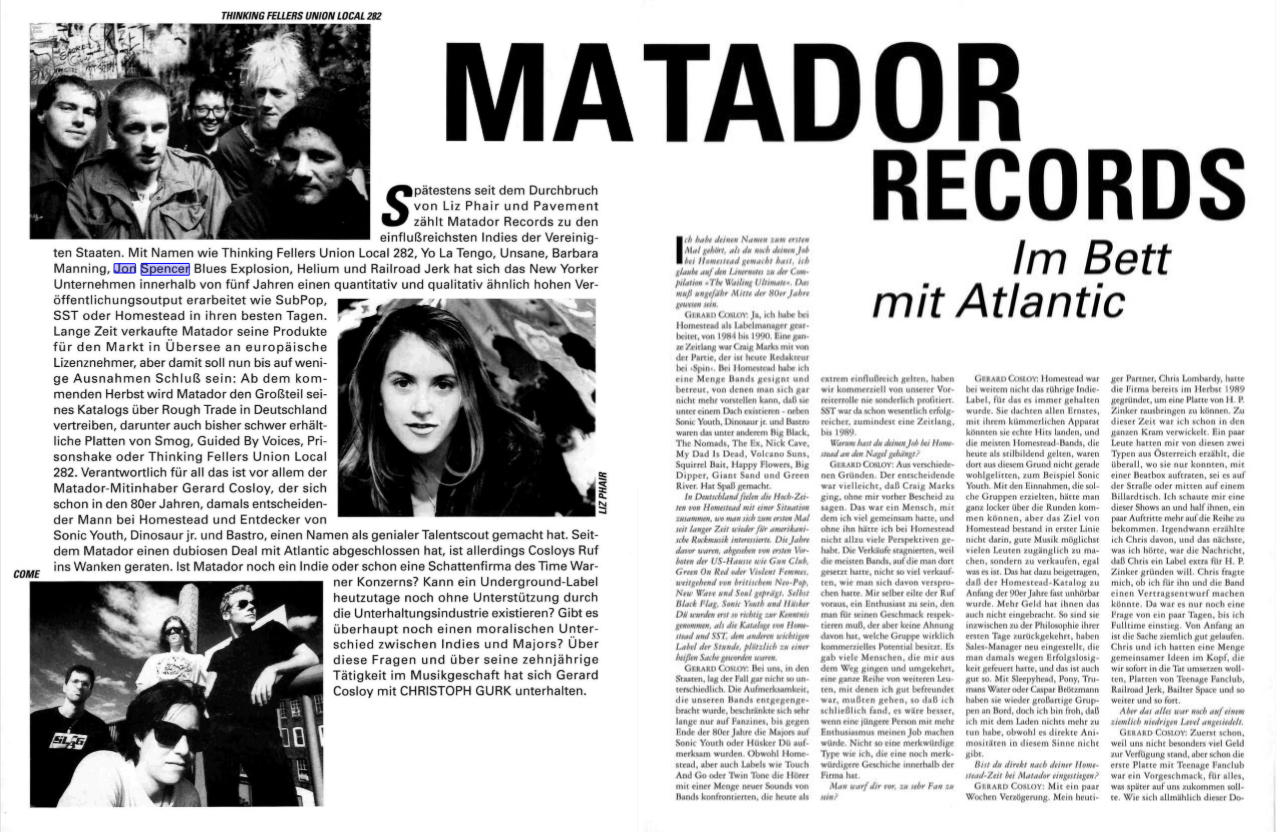
COME S considers Matador Records one of the most influential independent labels in the United States. With names like Thinking Fellers Union Local 282, Yo La Tengo, Unsane, Barbara Manning, Jon Spencer Blues Explosion, Helium, and Railroad Jerk, the New York-based company has, within five years, achieved a release output that is both quantitatively and qualitatively comparable to that of SubPop, SST, or Homestead in their heyday. For a long time, Matador sold its products for the overseas market to European licensees, but this is now set to end, with only a few exceptions: Starting this fall, Matador will distribute the majority of its catalog in Germany through Rough Trade, including previously hard-to-find records by Smog, Guided By Voices, Prisonshake, and Thinking Fellers Union Local 282. The driving force behind all this is primarily Matador co-owner Gerard Cosloy, who made a name for himself as a brilliant talent scout back in the 80s, when he was a key figure at Homestead and discovered Sonic Youth, Dinosaur Jr., and Bastro. However, since Matador entered into a dubious deal with Atlantic, Cosloy’s reputation has been tarnished. Is Matador still an indie label or already a front company for the Time Warner corporation? Can an underground label still exist today without support from the entertainment industry? Is there even a moral difference left between indies and major labels? Gerard Cosloy spoke with Christoph Gurk about these questions and about his ten years in the music business. LIZ PHAIR
00
MATADOR at the latest since the breakthrough of Liz Phair and Pavement Records
I first heard your name when you were still working at Homestead, I think on the liner notes for the compilation The Wailing Ultimate. That must have been around the mid-80s
GERARD COSLOV: Yes, I worked at Homestead as a label manager from 1984 to 1990. Craig Marks was also involved for a while; he’s now an editor at Spin. At Homestead, I signed and managed a lot of bands that you wouldn’t even imagine existing under one roof today—besides Sonic Youth, Dinosaur Jr., and Bastro, there were Big Black, The Nomads, The Ex, Nick Cave, My Dad Is Dead, Volcano Suns, Squirrel Bait, Happy Flowers, Big Dipper, Giant Sand, and Green River, among others. It was fun
In Germany, Homestead’s heyday coincided with a period of renewed interest in American rock music for the first time in a long while. The preceding years, aside from early harbingers of the US boom like Gun Club, Green On Red, and Violent Femmes, had been largely dominated by British neo-pop, new wave, and soul. Even Black Flag, Sonic Youth, and Hüsker Dii only really gained traction once the catalogs of Homestead and SST, the other major label of the time, suddenly became a serious commodity
GERARD COSLOY: For us in the States, the situation wasn’t all that different. The attention our bands received was limited to fanzines for a very long time, until towards the end of the ’80s when the major labels took notice of Sonic Youth or Hüsker Dü. Although Homestead, but also labels like Touch and Go or Twin Tone, exposed listeners to a lot of new sounds from bands that are now considered
In Bed with Atlantic
extremely influential, we never really benefited commercially from our pioneering role. SST was much more successful, at least for a while, until 1989.
Why did you quit your job at Homestead?
GERARD COSLOY: For various reasons. The decisive one was perhaps that Craig Marks left without telling me. He was someone I had a lot in common with, and without him, I wouldn’t have had many prospects at Homestead. Sales were stagnating because most of the bands they’d backed weren’t selling as well as they’d hoped. I myself had a reputation for being an enthusiast whose tastes you have to respect, but who has no idea which group actually has commercial potential. There
were a lot of people who avoided me and vice versa; a whole bunch of other people I was good friends with had to leave, so I finally thought it would be better if a younger person with more enthusiasm did my job. Not some weirdo like me, who has an even weirder history within the company.
You were accused of being a fan of your own band?
GERARD COSLOV: Homestead was far from the bustling indie label it was always perceived to be. They seriously thought they could land real hits with their meager operation, and most of the Homestead bands now considered seminal weren’t exactly popular there for that reason, Sonic Youth for example. The revenue such groups generated would have easily covered their expenses, but Homestead’s primary goal wasn’t to make good music accessible to as many people as possible, but to sell it, no matter what it was. This contributed to the Homestead catalog becoming almost unlistenable by the early 90s. It didn’t bring them any more money either. So they’ve since returned to the philosophy of their early days, rehired sales managers who had been fired back then for lack of success, and that’s a good thing With Sleepyhead, Pony, Trumans Water, and Caspar Brötzmann, they have some great groups on board again, but I’m glad I’m no longer involved with the label, although there aren’t any direct animosities in that sense.
Did you join Matador directly after your time with Homestead? GERARD COSLOY: With a few weeks’ delay. My current
partner, Chris Lombardy, had already founded the company in the fall of 1989 to release an H. P. Zinker record. By that time, I was already involved in all that stuff. A few people had told me about these two guys from Austria who performed beatboxing wherever they could, whether on the street or in the middle of a pool table. I went to one of their shows and helped them get a few more gigs booked At some point I told Chris about it, and the next thing I knew, Chris was going to start a label specifically for H. P. Zinker. Chris asked me if I could draft a contract for him and the band. From then on, it was only a matter of a few days before I joined full-time. Things went pretty well from the start. Chris and I had a lot of ideas we wanted to put into action right away: records by Teenage Fanclub, Railroad Jerk, Bailter Space, and so on and so forth.
But all of this was still on a pretty low level. GERARD COSLOY: Initially, yes, because we didn’t have a lot of money, but even the first record with Teenage Fanclub was a taste of what was to come. How this do- gradually developed
You can’t see the forest…
MATADIR
The mino effect kicks in, starting with the first fanzine articles, later the first orders from record stores, then the first big features, until finally all the assholes in the record industry are kissing your ass. It was strange.
Meanwhile, this situation has intensified. Since the Liz Phair debit, Matador has been a rapidly expanding label, and the last Pavement album, for which IBR holds the US rights, should have cemented this status
GERARD COSLOY: Yes, Liz Phair is, besides Pavement, our most commercially successful artist. Although, since working with Bettie Serveert and Come, we’ve been used to thinking in broader terms. As for Liz Phair, I have to say that her success didn’t happen overnight. It was the first time we consciously aimed to break an artist, as it’s called. However, I don’t mean to suggest that the success of this record was solely due to our marketing efforts. You can never plan an artist’s breakthrough; there are too many unknowns in the mix. A record still has to resonate with people if it’s going to be successful.
Did you anticipate Liz Phair’s potential when you signed her?
GERARD COSLOY: When I first worked through her demo tape, I knew immediately that this was one of the greatest things I had ever heard in my life. But if someone had told me that we would sell a quarter of a million copies, I would have laughed in their face. Even if it had only been 30,000 units, I would have said to myself: Shit, I can’t believe it, 30,000 Liz Phair records. Liz herself thought differently. She was convinced from the very beginning that she would become rich and famous.
To which I simply replied: You may or may not be right, but we’ll do our best.
I think you could already tell that the record would have a massive crossover effect when the first articles appeared in Billboard or Newsweek, and that was happening weeks before the official release date
GERARD COSLOY: Sure, by that point you had to expect anything. It’s incredible how quickly information spreads these days, even from people you don’t cooperate with at all. In Liz Phair’s case, bootlegs of the album existed before it even hit the stores. It was a similar story with Pavement’s Slanted and Enchanted. Both albums were also the most anticipated releases in Matador’s history. But let’s not keep talking about sales figures, that has to
I do that often enough in the office. Not that I want to fixate on this aspect, but you can simply disregard it. The power and significance that Matador exerts, and which certainly also has an impact on the economic structure of the US underground, is due precisely to these box office successes, without wanting to diminish the artistic aspect, to the contrary. These are just two sides of one and the same phenomenon…
GERARD COSLOY: Absolutely right, only I’ve been a bit tired of constantly talking about this phenomenon in recent weeks…
which also has its political side, because when Matador sells around 250,000 copies of an album with rather rigid feminist content, that’s not just an economic success, certain content has also been established on a mass basis
GERARD COSLOY: I don’t find the content all that radical. Liz Phair is above all a great song-
writer. I like her music. Even if you consider it an achievement that mainstream listeners also subject themselves to this record, you have to add that Liz Phair’s success wouldn’t have been possible without the Riot Grrrl or artists like Jean Smith, PJ Harvey, or Tara Key. The radical female artist who has something to say, all that blah blah blah, had been a huge topic long before. If you add in the status that Juliana Hatfield and Tori Amos held at that time, you can’t avoid the conclusion that Liz Phair, a young, good-looking woman with sex appeal, simply closed the gap between the underground and the mainstream. The world wasn’t just prepared for this; it was practically waiting for it. I don’t deny that this is also a political success. The world has changed, and the market has changed. But when you analyze that, you have to be precise
>>When I realized that we couldn’t survive without support from a major label, I wondered where the moral difference lies between a major and an indie label. It’s certainly not ethically sound to alienate your bands for the sake of financial independence.<
I suspect you got into the music business as a fan at some point, and probably you always have. Nevertheless, the drastic changes in the business, for example, the increasing degree of professionalization, must have affected your perception of music. Do you still enjoy the job?
GERARD COSLOY: Let's say I enjoy it less than I did eight years ago. I have to talk to more assholes to make a record
To push it through, I have to devise marketing strategies, anticipate expectations, in order to survive at the level where Matador currently is. However, I'd be a fool to complain about it at length, because the bands we work with don't give a damn what I think about this or that. They expect their records to be in the shops, and that's their right. Just having cool views—lots of people do that. But who tries to turn that into a company policy that actually works?
Does Matador have something like a label philosophy?
GERARD COSLOY: From an artistic point of view, we're all about aesthetic brilliance. I would never release an album that I didn't personally like, and what I like can vary greatly. There are no dogmas. The only other thing that connects our groups is perhaps the fact that they all operate more or less within certain contexts that one could call alternative, if that word hadn't lost all meaning by now. And we want to prove with our work that you can sell something like that without making any concessions to so-called public taste. You can market an album in a way that doesn't insult the intelligence of most people. We want to and can remain independent, just as we, as a label, don't want to influence the artistic decisions of our musicians. If that works, we've already gained more than many other companies
Regarding financial independence, your company has been the subject of quite a bit of talk since Matador signed a distribution deal with the major label Atlantic, effective January 1, 1993. There has been a lot of conflicting
from the trees
speculation about the details. Can you give us a rough outline of what the deal entails?
GERARD COSLOY: Atlantic gave us a lot of money. With this money, we are able to pay our bands, we can ensure that the records are released on time, we can employ more people to make sure that these records are sold.
The rumor that all Matador stuff is handled by Atlantic is false?
GERARD COSLOY: That's not true. So far, only The Fall, Yo La Tengo, Unsane, and a few reissues are distributed by Atlantic. Did you achieve the sales figures for Liz Phair and Pavement on your own?
GERARD COSLOY: Every band can decide for themselves how they want to be distributed. Liz Phair and Pavement have spoken out against Atlantic.
That sounds too good to be true! What interest could a company like Atlantic have in financing Matador if the most profitable groups remain independent? Some claim that Matador itself is already 10 percent owned by Atlantic. You and Chris would just be pawns
GERARD COSLOY: That's absolute nonsense! Matador belongs 100% to Chris and me. Here's how it works: Atlantic and WEA finance everything, I mean everything, we do. They pay our rent, our expenses, our staff, our debts. In return, we're obligated to release some of our products together with Atlantic, although, as I said, the bands can decide whether they want to or not. The profit from these projects goes 100% back to Atlantic. For everything we release independently of Atlantic, 50% of the revenue goes back to Atlantic. The rest belongs to Matador. And I want to emphasize that the contract grants us and the bands 100% artistic freedom, from the music to the artwork to the content of our
marketing activities. Why didn't Atlantic just create their own sublabel for alternative bands?
GERARD COSLOY: That would have cost them even more money. They would have had to hire five A&R people at five times the price of their expenditure on Matador
to get things going, and they still would have gotten fewer and significantly worse bands. Matador is very likely the best source of talent in the United States, and its representatives carry a lot of weight in the scene. Sure, Atlantic also invested in credibility.
Now, you owe a not insignificant part of your credibility to the fact that you have made a name for yourself in the past as the toughest critic of major-label politics. Don't you see a contradiction with your earlier statements?
GERARD COSLOY: We had no other choice. Just like today, hardly any indie label in the US, and it's probably no different for you in Germany, can exist long-term without support from majors. When that dawned on me, I asked myself where the moral difference lies between a major and an indie label. It's certainly not ethically sound to alienate your bands for the sake of financial independence.
You once said that the history of major labels is an endless history of rape. And you're in bed with a major
GERARD COSLOY: The last thing we want is to destroy the underground infrastructure. We release the majority of our material through an indie distributor. Additionally, Matador handles the production and distribution of records released by financially weaker labels, for example, releases on TeenBear, Scar, or Simple Machines. And for the past few months, we've been distributing the majority of our releases, which were previously sold to licensees overseas, under our own logo through indie distributors in Europe; in Germany, that's Rough Trade. As part of a larger release offensive, we'll also be adding records by Smog, Prisonshake, and Guided By Voices to our European lineup. These were previously hard to find in your area because they're released in the US on labels that are completely overwhelmed by export activities. Are you completely satisfied?
GERARD COSLOY: Of course not, but I don't want to bore you with details about all the crap that's going wrong. Let's just say: Yes, Matador is in with Atlantic, and the question is who's on top in this deal. We'd like to be the exception to the rule"