Jon Spencer
“Our rock and roll is respected in the UK and Japan.”
Special feature: British tastes
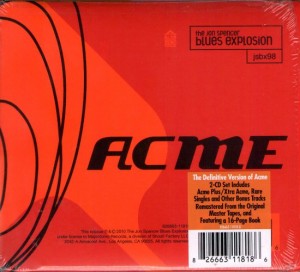
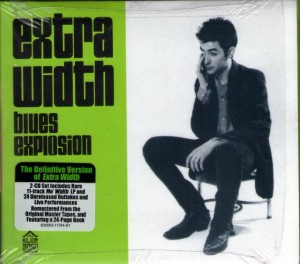
“Acme” expanded into “Extra Acme” and “Ura Acme,” and they came to Japan almost every year, so it didn’t feel like it had been that long, but Jon Spencer Blues Explosion (JSBX)’s new album, “Plastic Fang,” is their first in four years. Coincidentally, the garage trio King Brothers, originally from Nishinomiya, have just released their new album, “6×3,” produced by Jon Spencer. Interestingly, “6×3” features Jon’s guitar, organ, and percussion overlapping with his son’s voice, creating a lively, expected JSBX style, while “Plastic Fang” surprisingly has a straightforward JSBX sound.
What’s more, it was produced by Steve Jordan. Of course, listening to it, it’s unmistakably a work brimming with JSBX passion, and rather than becoming more crooked, it seems to have become even more straightforward, but what has changed in these four years? If we dare to misinterpret it, it could be interpreted as an American alternative style that is popular in the UK these days. Of course, Jon had no such intention, but I interviewed him with this in mind.
Although it may seem unnecessary, I will explain the facts. The album “6×3” was titled by Jon, and was recorded in Tokyo and sent to Jon.
The album was completed with the addition of Jon. In other words, Pando and Jon were not in the studio at the same time, but the King Brothers toured the US a few months prior and visited John for a session. There are rumors that the recordings from that time will be released at some point, but the date is currently undecided.
We can’t make a song unless all three of us are together.
—You produced the King Brothers’ album, right? They said they were truly grateful for the wonderful work they produced. They said they were “enchanted.”
“(Laughs) I love the King Brothers too. The shirt that Jun (drummer) is wearing on the album cover is the one he wore on Pussy Galore’s album “Right Now!” released in 1988. I liked it, but it’s not mine anymore, it’s his (Laughs).
This is how things are passed down.” – Just like rock and roll. “That’s it.”
—While producing them, did you ever think of Pussy Galore? The album title and cover are similar to the Rolling Stones’ 12×5, and Pussy Galore has also done covers of Stones songs.
“Not at all. Not just for them, but whenever I’m asked to produce something and I’m told I can do whatever I want, I try to create something that’s completely different from what you’d normally hear.”
—After the sessions with the King Brothers, did you start working on JSBX’s “Plastic Fang”?
“No, it was a mix I did around that time… maybe around Christmas. A lot of things were going on at the same time.”
—So, when did this work start?
“It was in June of last year.”
—After “Acme,” was there no momentum for recording?
“That’s not the case. After “Acme,” we toured for about a year, then released “Extra Acme”… After that, we had a period of about a year where we didn’t do anything, but we got together again and performed the songs we wrote for this album. That’s it.”
We’ve also been touring and doing things like that. Our stance hasn’t changed: we release our albums when we want to, not because the record company tells us to.”
—So this time too, you three have time together and the songs are all ready?
“I guess so. It’s always ‘right time.’”
—Do you create songs that are distinct from, for example, Boss Hog?
“JSBX cannot exist without all three members.”
–Can’t you make a song unless all three of you are together?
“That’s right.”
–So the lyrics don’t come until you can write the song?
“They’re usually the same, songs and songs.”
–This time, Steve Jordan is producing.
-Why did you choose Dan?
“He’s a really nice guy, with a warm heart, and I’ve always loved his work. The organic feel and groovy, soulful feel that’s evident in Keith Richards’ solo work is fantastic. I’ve always admired that kind of thing. So, working together this time, I think he was able to bring out the best in us.”
—Did you ever want to produce it yourself?
“I’ve done enough on my own, so this time I wanted to produce from the outside and see what I could come up with.”
-Have you exhausted your production skills with the “Acme” series?
“With Acme, I was the executive producer. I organized a lot of different people and brought them together into one piece.”
–Do you feel like you’ve finally come to terms with creating a work that involves so many people?
“Hmm, I don’t know.”
– Because this time it was just the three of you and the producer recording, right?
“This time, we really wanted to have a traditional producer-band relationship like the old days. We felt that by bringing in a producer who could act as a father figure, like George Martin or Glyn Jones, he could help us grow.”
-So, was this simple performance a suggestion from the producer?
“Yeah, I think it was Steve Jordan who said it. His influence on this was huge, and he conducted it all.
But what we were able to achieve by hiring him this time wasn’t something that the record company set in motion, but rather something that we wanted to do, and he was there to help us achieve it.”
I only continued because it was fun.
–So JSBX’s will was at the core of it all. But wasn’t there a certain nostalgia to it? “Hmm? Nostalgia for what?”
Old rock and roll, traditional
Narcissistic music, etc.
“Yes, I suppose that was the feeling I had. But I don’t think of this album as a retro work, and it’s not a reconstruction of our past. JSBX has, of course, been greatly influenced by blues, R&B, old rock, and country and western up until now, and we have accumulated a lot of that influence. But rather than old music itself, we have adopted methodologies and techniques as needed. At the same time, we have also adopted new technology as needed. So we are a band of the present, and we are looking towards the future.
Of course. I didn’t mean to say it was negative, but I felt that it was that kind of approach.
“The traditional aspect, the fact that it can become a classic piece, is important to me. The way the songs are presented, how they’re performed, how the story of the songs is told is traditional and essentially unchanged. I’m always interested in that aspect.”
――――The song structures are very simple and orthodox, and the lyrics and refrains use common blues phrases. But the end result is something completely different. Is it magic, as the King Brothers say, that differentiates it from your past work?
“It’s not magic (laughs). If there is magic, I can’t say it’s this, but there is something that always exists between the three of us, and that is what creates a bond, and a kind of musical communication, which I think is what makes our sound. I think that is something very valuable. When creating music, for example, we don’t think of a concept first, or have any discussions at all. We just bounce whatever comes out of it off each other.”
” — You’ve probably been asked a million times, but why don’t you have a bassist in the first place? “In the beginning, it just happened that way.
-Have you ever thought about putting one in?
“We never even thought about starting a band, so it just happened naturally and we’ve come this far.”
I guess so. —But now, the fact that such a strong bond has been formed means that there is some special attraction.
“It was an accident (laughs). It was fun, so it continued.”
–When I hear how John and Judah (Bauer)’s guitars overlap, I get the feeling that they’re intentionally leaving out the bass to enhance their own creativity.
“We never once discussed adding a bass, but the absence of a bass leaves a space in the sound, which we think is important.”
I heard that you recorded this time using vintage equipment.
“Yeah, it was a lot of fun recording with this amazing equipment.”
Are you picky about instruments?
“no”
—I heard that your equipment was stolen about two years ago.
“Yeah, in Vancouver. With an amp. With Theremin”
–Was the theremin a valuable item?
“Yeah, it was a great antique Moog from the early ’60s. I don’t think you’ll ever get the same one again.”
–So that’s why you didn’t use the theremin this time?
“Yes, I use Killer Wolf and one other song that won’t be on the Japanese version.”
–We don’t use it as extensively as before…
“You’re using two songs. This time, I thought that was fine.”
Rock and roll is looked down upon in America
As I am not good at English, I had to use an interpreter for the interview. While we communicated in Japanese, Jhn was boredly looking through a magazine (not the official magazine, just to be clear) when he spotted an advertisement for Guitar Wolf. His eyes lit up as he ripped out the page. I happened to have a Guitar Wolf sample CD with me, so I gave it to John, who was delighted like a child and asked, “Really? Can I have it?” When I asked him why he liked them so much, he said, “Because they’re so cool! They really know what rock ‘n’ roll is! You can tell just by looking at them, whether it’s their appearance or the way they move!”
About five years ago, I started playing JSBX and guitar.
I saw Wolf perform with him in London, and I thought he must be even more welcome there than he was in America.
“It all depends on the day. Maybe it was because it was a full moon (laughs).”
Last month, they played a secret gig in London.
I heard you did it.
“Yeah, it was a promotion. Europe, Paris, London, and Cologne.”
–Are the reactions different in Europe? “No, it’s not really different anywhere else, but it’s fun.”
—You come to Japan almost every year, and I think JSBX is a very stimulating presence in places where blues and R&B are not as integrated into the cultural fabric as they are in Japan or Europe.
“Yeah, I know what you mean. In Japan and Europe, it feels like there’s a certain amount of respect for rock and roll. In America, there are definitely some people who look down on rock and roll.”
–Rock and roll is in a state of collapse on the hit charts. What are your thoughts on that?
“The charts make my music. It’s not going to motivate me. My interests are in a completely different world.
I don’t think that the dominance of the “old” things has changed from the past to the present. I don’t think I pay any attention to that.”
—Is it more difficult for the band to perform than before?
“Luckily, I’m busy and we’re working hard.
But we’re really grateful that people are interested in us, that we can continue doing what we want to do the way we want to do it, and that we can earn money and make a living from it.”
–It seems that layoffs of artists are happening frequently in the US as well. Do you ever feel a sense of crisis?
“I think JSBX is surrounded by great people. When you make music, you can’t do what you want under someone’s control. Instead, they’ve kept their stance of licensing what they make to labels they trust, so they’ve maintained an environment that protects their freedom. Of course, there are a lot of things happening around them, and they can’t turn a blind eye to it.
—So, carving out your own path and doing DIY is your driving force?
“That’s right. It started as a DIY project, and that spirit is what has allowed us to continue until now. Many people have made their own magazines.
I think it’s unacceptable, but I wonder if there’s any sympathy for the artists who are actually being fired. I think they have their own reasons for being fired.”
If you want to make something, make one. If you want to be in a band, do it. I think it would be good if that were the case.”
-Finally, is there a chance this one will turn out to be like the “Acme” series?
“No (firmly). Not as a big project. Well, maybe I’ll do one or two songs.”
While chatting with the staff after the interview, I overheard Jon say that he seems to be put off by the music scene in the UK. As he said in the interview, JSBX has stuck to its style because it doesn’t pander to anyone, so it’s no wonder they’re being hyped up with such gimmicky hype. Rather, when John saw Guitar Wolf’s tour schedule, he envied them, saying, “They’re doing so many shows? That’s amazing!”, and I thought that he was just as impressed by the music scene in Japan.
I wonder if I can get Eve to do it. She’s been saying things like, “Recently, I’ve been getting old, so my physical strength has been declining, and my hearing is a bit damaged.” If I’m going to let her do it, now is the time.”