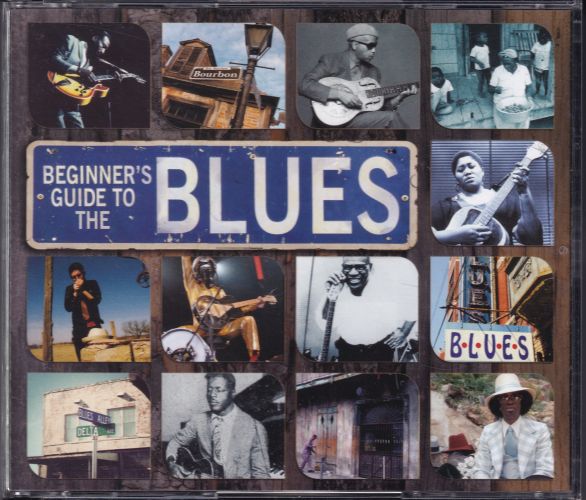
BEGINNER’S GUIDE TO THE BLUES
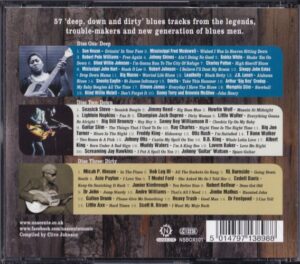
DEEP DOWN & DIRTY
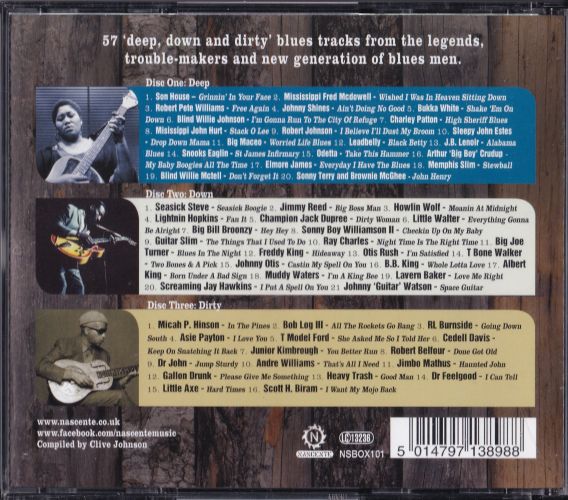
Disc one: Deep
The phrase Deep Blues comes from the US journalist Robert Palmer’s book “Deep Blues” of 1981. In the book Palmer tells the story of the blues through the lives of its greatest practitioners. Disc one features many of those innovators.
Jack White of The White Stripes has cited Son House’s a cappella song, ‘Grinnin’ in Your Face’, as his favourite song, so what better way to start a song with a message for us all.
Apparently Mississippi Fred McDowell didn’t own a guitar until he was 37 years old, and worked as a farmer until he was over 60. Just as he was about to have a comfortable retirement due to the Rolling Stones LP ‘Sticky Fingers’ featuring a cover of his tune ‘You’ve Got To Move’ he sadly died.
Robert Pete Williams was serving a life sentence in prison for shooting a man dead when he was discovered. His songs are about the time he served in prison; the ironically titled ‘Free Again’ is about being trapped not by bars but by the strict rules and regulations of his harsh parole.
As the travelling partner of Robert Johnson, Johnny Shines own contribution to the history of the blues has been a little overlooked. However ‘Ain’t Doing No Good’ is a storming example of his own energised style of slide guitar.
Continuing the association of blues musicians and prison, Bukka White recorded ‘Shake Em On Down’ after being convicted for assault, shooting a man in the thigh. One version of events is that this recording was made when White jumped bail before the sentence was passed.
In contrast to the blues & crime connection, Blind Willie Johnson was a Baptist preacher. I’m Gonna Run To The City Of Refuge’ is a perfect example of his religious themed Gospel Blues featuring his gravely false- bass voice.
According to reports of the time, Charley Patton was the first blues star: rakish, raffish and highly temperamental with a huge appetite for liquor and women. He had an expensive guitar that would only come out if the money or the good times justified it.
Misissippi John Hurt recorded ‘Stagger Lee’, however there are versions called ‘Stagolee’, ‘Stackerlee’, ‘Stack O’Lee’ and ‘Stack-a-Lee’ all the same song just different names. The lyrics are based on the death of William Lyons. It is a tragic tale of alcohol, arguments, hats & murder.
Robert Johnson famously sold his soul to the Devil at the crossroads in return for success. This success was presumably only with music as the lyrics to ‘I believe I’ll dust my broom’ suggest he has serious woman trouble.
Sleepy John Estes lost the sight of his right eye when a friend threw a rock at him. His nickname ‘Sleepy’ has several explanations, some say he had a blood pressure disorder and/or narcolepsy, others say he would withdraw his attention from his surroundings if he became bored. Another explanation is that it was due to his ability to sleep standing up. ‘Drop Down Mama’ became a blues standard in the repertoire of many musicians.
‘Worried Life Blues’ is one of the most recorded blues songs of all time. It was an early blues hit and Big Maceo’s most recognised song. The song is based on Sleepy John Estes ‘Someday Baby Blues’. Despite being a self-taught pianist, Big Maceo’s style affected nearly every blues pianist that followed.
The iconic Lead Belly takes us back to blues musicians and prison. Lead Belly was imprisoned twice for murder and once for possession of a pistol. The Black Betty in the title may refer to a variety of possibilities, but is generally thought to be the whip that was used in the Southern prisons. There are many versions of this song, but Lead Belly’s is the best known.
JB Lenoir was a showman, even down to the zebra- patterned costumes he wore. However, his music had a strong focus on social commentary, which separated him from other blues musicians in the 1950’s. ‘Alabama Blues’, written in 1963 is a powerful and moving example influenced by the Civil Rights Movement.
There are many versions of ‘St. James Infirmary Blues’, the song is based on an 18th century traditional English folk song about a soldier who spends his money on prostitutes and then dies of a venereal disease. Snooks Eaglin seems to have avoided the issue of morally questionable behaviour concerning how ‘his baby’ died.
As well as a guitarist, singer and actress Odetta was also a prominent civil and human rights activist and was nicknamed ‘The Voice of the Civil Rights Movement’. Time Magazine included her version of the old prison song “Take This Hammer’ on its list of the All-Time 100 Songs and mentioned, ‘Rosa Parks was her No. 1 fan, and Martin Luther King Jr. called her the queen of American folk music’
Three of Arthur ‘Big Boy’ Crudup’s tracks were recorded by Elvis Presley at his peak of his rockabilly phase: “That’s All Right Mama’, ‘So Glad You’re Mine’, and ‘My Baby Left Me.’ Because of this, and a little unfairly, Crudup’s own contribution to blues gets slightly lost. ‘My Baby Boogies All The Time’ is a fine example of Big Boy at his best.
Elmore James; king of the slide guitar. There was a dispute between Robert Johnson and Elmore James as to which of them actually wrote ‘I believe I’ll dust my broom’ so to avoid any argument, ‘Everyday I Have The Blues’ is included here, which is unquestionably a Memphis Slim track.
And here is Memphis Slim, the big- voiced blues pianist and singer, here with legendary bassist Willie Dixon, credited with having helped create the Chicago blues sound. ‘Stewball’ is another song to have roots in an 18th century European folksong. This one is about a racehorse, but not just any racehorse.
Artists who acknowledge the influence of Blind Willie McTell range from Bob Dylan, Taj Mahal, Alvin Youngblood Hart, to The White Stripes. McTell played a 12 string guitar, and had a laid back vocal approach that was very different to the abrasive vocals of a lot of the Delta blues men. ‘Don’t forget it’, showcases this beautifully, a great track form a blues giant.
The folk boom of the late 1950’s and early 1960’s made Brownie McGhee and Sonny Terry household names. They were a prolific and hard touring double act until the mid 1970’s when they called it a day. There are many versions of this folk song that tell the legend of John Henry; a steel-driver whose prowess was measured in a race against a steam powered hammer which he won only to die in victory with his hammer in his hand.
Disc two: Down
Robert Palmer defined rhythm & blues as ‘a catchall term referring to any music that was made by and for black Americans’. On this CD the definition is narrowed down to blues dance music, blues to … get down to! More commercial and inter racial, this disc deals less with hardship and more with boogie.
Starting off with a contemporary take on a boogie shuffle, Seasick Steve’s, ‘Seasick Boogie’ is a great groove, a great vibe, and a great song.
Jimmy Reed was one of the first major players in the 1950’s to bring the electric blues to a more mainstream audience. ‘Big Boss Man’ was one of several hits. Reed had a significant impact on those that followed. Many, including Elvis Presley and The Rolling Stones, acknowledged his influence.
Sam Phillip, owner of Sun Records said of Howlin Wolf ‘This is where the soul of man never dies.’ While the critic Club Koda said ‘A Robert Johnson may have possessed more lyrical insight, a Muddy Waters more dignity, and a B.B. King certainly more technical expertise, but no one could match him for the singular ability to rock the house down to the foundation while simultaneously scaring its patrons out of its wits’. ‘Moanin’ At Midnight’ is the title track of Wolf’s 1959 debut album.
Also from 1959 is Lightnin’ Hopkins ‘Fan it’. Hopkins bridged the gap between the rural and urban styles. The album ‘Lightnin’ Hopkins’ from which this track is taken, signalled his rediscovery, it was met with immediate critical acclaim and soon became recognised as a blues classic.
Champion Jack Dupree was a boxer before turning to his attention to a full time career as a blues pianist. ‘Dirty Woman’ is a bonus track from his 1958 album for Atlantic ‘Blues From The Gutter’. Generally regarded as his masterpiece, the album is a great testament to his barrelhouse style background. Dupree was also one of the first blues musicians to leave the US in 1959 to live in a more racially tolerant Europe.
Little Walter had such a revolutionary approach to the harmonica that he has been compared to Jimi Hendrix. His innovations were so ahead of their time they could not fail to have an impact on all that followed, his dazzling virtuosity completely changed what was possible from the instrument. ‘Everything Gonna Be Alright’ was a 1959 single for Chess Records. Little Walter is reputed to have had a vicious temper and his death in 1968 was as result of the injuries sustained in a street fight.
Big Bill Broonzy had a long and prolific career from the 1920’s to his death in 1958. He started out performing country blues but was able to make the switch to urban blues in the 1940’s. However, in the 1950’s he made a return to his traditional folk blues roots and this cemented his position as one of the main figures of the American folk music revival and an international star. ‘Hey Hey’ from 1951 has a great natural foot tapping rhythm.
Singer and harmonica player Sonny boy Williamson II recorded the blues classic ‘Checkin’ Up On My Baby’ in 1960. It was never released as a single but became his most recorded track. Williamson toured extensively in Europe at the height of the British blues craze and according to the Led Zeppelin biography ‘Hammer of the Gods’, on one occasion set his hotel room on fire trying to cook a rabbit in a coffee percolator.
‘The things I used to do’ was Guitar Slim’s biggest hit; it was recorded in 1953 and was produced and arranged by Ray Charles. The following year the track became a massive success selling over a million copies but unfortunately Slim would never chart again. A flamboyant showman, Slim influenced many of the later rock guitarists in both stage manner and by his experiments with a distorted electric guitar sound.
Staying with the Ray Charles theme, ‘Night Time Is the right Time’ was a slow gospel based tune by Nappy Brown. Ray Charles took the song and made it an up-tempo number. It then became a hit in 1959, when it reached number 5 in the Billboard R&B Chart and number 95 in the pop chart. The song is included on the classic Ray Charles album ‘The Genius Sings the Blues’.
The song writer Doc Pomus said of Big Joe Turner ‘Rock and Roll would have never happened without him.’ Bill Haley & The Comets covered his track, ‘Shake Rattle And Roll’ and history was made. ‘Blues In The Night’ is a far more sedate affair.
Freddy King’s massive 1961 instrumental ‘Hide Away’, reached number 5 on the Billboard R&B Charts and number 29 on the Pop singles charts. ‘Hide Away’ was acknowledged by King to be a conglomeration of several tunes, including a theme by Hound Dog Taylor, and other parts from ‘The Walk’ by Jimmy McCrackiln and ‘Peter Gunn’, while the title is from Mel’s Hide Away Lounge, a Chicago blues club.
Despite a distinctive sound featuring his ringing vibrato guitar work and influencing many guitarists that followed, Otis Rush never achieved the mainstream recognition he was really due. ‘I’m satisfied’ was the B side to his Chess debut single ‘So Many Roads So Many Trains’ and is a killer slice of R&B.
So to another stunning instrumental, T Bone Walker’s ‘2 Bones & a Pick’ from the Atlantic album ‘T Bone Blues’. T Bone Walker was the father of the modern electric blues guitar. This recording is from a 1956/1957 session but still sounds as fresh today as it would have back then.
Throughout his long career as drummer, singer, composer and producer Johnny Otis was referred to as the ‘Godfather of Rhythm and Blues’. ‘Castin My Spell on You’ is a fantastic dance track jam packed with voodoo and black magic references.
B.B. King is one of the most influential blues musicians of all time. King has a unique sound that mixes blues, jazz, swing and mainstream pop. The sparseness of his playing has influenced guitarists from Eric Clapton and George Harrison to Jeff Beck amongst many, many others.
Albert King’s first album for Stax records, ‘Born under a bad sign’ in 1967 has been credited with modernising the blues and saving it from becoming a cliché of itself. The album features possibly the greatest rhythm section ever as King’s backing band: Booker T & the MGs. ‘Born under a bad sign’ became a modern blues classic with notable versions by Cream & Jimi Hendrix.
Slim Harpo originally recorded ‘I’m the King Bee’ in 1957; Muddy Waters recorded this version for his final album ‘King Bee’ in 1981. King Bee was the third in a series of albums produced by Johnny Winter, the first being Waters classic comeback album, 1977’s ‘Hard Again’.
‘Love Me Right’ is from Lavern Baker’s 1959 Atlantic album ‘Blues Ballads’. The song is gritty and raw but the energy in the vocal delivery makes it a stunning performance.
Screaming Jay Hawkins recorded ‘I put a spell on you’ in 1956. Apparently the track was supposed to be a refined ballad, however at the recording session the band were blind drunk and Hawkins screamed, shouted and grunted his way through it. Hawkins claimed to not remember the session having passed out yet the track was his most successful ever, selling well over a million copies.
Johnny guitar Watson’s ‘Space Guitar’ pioneered the use of feedback and reverb. Although it sounds quite tame now, in 1954 when the track was recorded, it was revolutionary, and pre empted similar experiments by Jimi Hendrix and Frank Zappa.
Disc three: Dirty
The tradition of dirty blues involved songs concerned with taboo subjects, mainly sex and drugs, and were most popular in the 1930’s. In the case of CD3, Dirty refers to the sound of the music: rough, guttural, distorted, and really just downright dirty!
Micah P. Hinson’s version of the Lead Belly song ‘In The Pines’ starts CD 3 with a statement of intent, a full frontal assault of fuzz, white noise and distortion. A traditional blues song reinterpreted for a new audience and still sounding as powerful as ever.
Bob Log III is either a genius or a madman, although, most likely … both. There is a rumour that Log had a monkey paw grafted on to his wrist after a boating accident as a child, however he has in fact denied this. Log wears a motorcycle helmet with a telephone receiver wired in, through which he sings, allowing him to devote his hands and feet to slide guitar and drums. ‘All the Rockets Go Bang’ is a modern classic.
Despite performing for most of his life RL Burnside did not gain much attention until he was in his 60’s. Burnside’s music is in the tradition of the delta blues but his style was edgier and raw and it was the recordings he made with The Jon Spencer Blues Explosion that brought his music to the alternative rock scene. Burnside recorded several electric and acoustic versions of ‘Going Down South’ – we’ve included the definitive one.
Asie Payton only released one album: ‘Worried’, sadly it was released posthumously. I Love you’ has a beautiful smooth delta blues vocal line, which is fantastically disrupted 13 seconds in by an unholy racket that makes this track wonderful.
T Model Ford did not start his musical career until he was in his 70’s, prior to that he lived an almost textbook blues life; in a dysfunctional and violent environment he worked ploughing fields, at a sawmill, as a lumber company foreman and truck driver, with a prison sentence for murder thrown in as well.
Cedell Davis has a distinctive style of guitar playing – he uses a knife in his fretting hand as if playing slide guitar. This effect of the knife on the guitar strings creates fascinating harmonics. Davis developed this style from the age of 10 when he suffered from severe polio that left him little control over his left hand and restricted use of his right. Further tragedy followed, while playing in a club in 1957, a police raid caused the crowd to stampede over Davis. Both of his legs were broken and he had to use a wheelchair since. These incidents have been a big influence in his lyrics and style of blues.
Junior Kimbrough’s music has similarities to RL Burnside, and the Kimbrough and Burnside families have collaborated together. Kimbrough’s style has more of a hypnotic drone as it locks into a groove. A busy man, Kimbrough reportedly had 36 children and ran Junior’s Place’ a juke joint in Mississippi; high profile visitors included Keith Richards and Iggy Pop. ‘You Better Run’ deals with unsavoury subject matter told from three points of view, a narrator, the victim and the perpetrator.
Both R.L. Burnside and Junior Kimbrough particularly influenced Robert Belfour. Like them, a mainstream audience did not discover him until he was into his later years. Belfour worked in construction before his first release aged 54. ‘Done Got Old’ is a Junior Kimbrough song about the effect of time on us all.
Dr John was billed as “Dr. John, The Night Tripper” on his earliest records, the name “Dr. John” came from a legendary Louisiana voodoo practitioner of the early 19th century. ‘Jump Sturdy’ is taken from ‘Gris Gris’, his 1968 debut album combining voodoo rhythms and chants with the New Orleans music tradition.
Andre Williams has been involved with music legends such as Ike Turner and Edwin Starr since the 1960’s, however it was recordings with both Jon Spencer and The Dirt Bombs that brought out his punk rock blues side. That’s All I Need’ is a calmer track that shows his lyrical wit and his laid back vocal style to great effect.
Jimbo Mathus’s ‘Haunted John’ is from the Blue Light album released on the groundbreaking Fat Possum label. The track is a mish mash of all his influences, which are really the influences represented in most modern blues.
Gallon Drunk’s version of the swamp blues track ‘Please Give Me Something’ has everything that is needed in a classic dirty blues track: a distorted filthy bass, evil sounding guitars and a vocal line that descends into shouting.
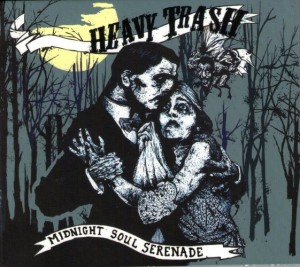
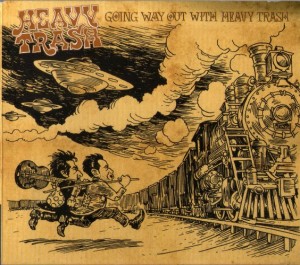
Heavy Trash is a project formed by Jon Spencer of The Jon Spencer Blues Explosion and Matt Verta-Ray. As with the Gallon Drunk track previously, ‘Good Man’ is a brilliant example of sleazy swamp blues.
Dr Feelgood epitomised the blues driven UK pub rock scene of the mid 1970’s. Their cover of Bo Diddley’s ‘I can tell’ is raw and very rough. This track clearly demonstrates why Dr Feelgood was such a huge influence on the punk rock movement that was about to explode.
‘Hard Times’ is a version of the Skip James track ‘Hard Times Killing Floor Blues’, which has been recorded by many artists. The Little Axe version is a dark sonic sound clash of dub, gospel and blues. This is truly blues for the 21st century.
Disc three ends with Scott H Biram, from Austin Texas, one of the main figures keeping the tradition of the one-man band alive. ‘I Want My Mojo Back’ is lo fi and gritty, and a great way to round off this trip around the blues.
Clive Johnson, January 2013
Thanks to Andrew Cousins