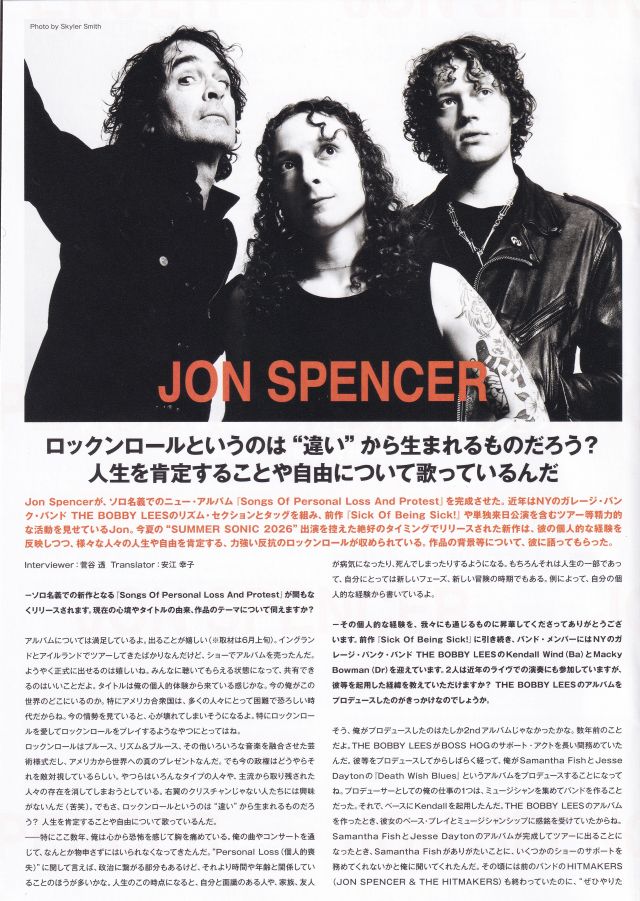
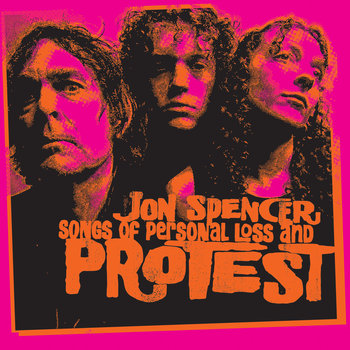
“Jon Spencer has completed a new solo album titled *Songs Of Personal Loss And Protest*. In recent years, he has been energetically active—teaming up with the rhythm section of the New York garage-punk band The Bobby Lees for his previous album, *Sick Of Being Sick!*, and touring, including solo shows in Japan. Released at the perfect moment ahead of his appearance at “SUMMER SONIC 2026” this summer, this new record features powerful, defiant rock ‘n’ roll that reflects his personal experiences while affirming the lives and freedom of people from all walks of life. We spoke with him about the background of the album and more.
—Your new solo album, *Songs Of Personal Loss And Protest*, is coming out soon. Could you tell us about your current state of mind, the origin of the title, and the themes of the work?
I’m happy with the album. I’m glad it’s finally coming out. I’ve just finished touring England and Ireland, where I was selling the album at shows, so it’s great to finally have the physical release ready. It’s a good feeling to have it in a state where everyone can hear and share it. As for the title, it really stems from my own personal experiences—reflecting on where I stand in the world right now. Especially in the United States, these are difficult and frightening times for so many people. Looking at the current situation, it’s enough to break your heart—particularly for someone like me who loves and plays rock ‘n’ roll. Rock ‘n’ roll is an art form born from the fusion of blues, rhythm & blues, and various other styles; it’s a genuine gift from America to the world. Yet, the current administration seems to view it with hostility. They’re trying to erase the existence of all kinds of people—those left on the margins of the mainstream. They have no interest in anyone who isn’t a right-wing Christian (laughs). But rock ‘n’ roll is born from “difference,” isn’t it? It’s about affirming life and singing about freedom. Especially over the last few years, I’ve felt genuine fear and heartache. I’ve reached a point where I simply have to speak out through my songs and concerts. Regarding the “Personal Loss” aspect—while there are political connections, it has more to do with the passage of time and aging. At this stage of life, you start seeing people you know—family and friends—fall ill or pass away. Of course, that’s part of life, but for me, it also marks a new phase—a new adventure. As always, I’m writing from my own personal experience.
—Thank you for elevating that personal experience into something that resonates with all of us. Following your previous release, *Sick Of Being Sick!*, you’ve once again enlisted Kendall Wind (bass) and Macky Bowman (drums) from the New York garage-punk band The Bobby Lees as your bandmates. They’ve been performing at your recent live shows as well; could you tell us how you came to work with them? Was it because you produced The Bobby Lees’ album?
Right—I think I produced their second album. That was a few years ago. The Bobby Lees had been the support act for Boss Hog for a long time. Some time after producing them, I was tapped to produce the album *Death Wish Blues* for Samantha Fish and Jesse Dayton. Part of my job as producer was to assemble a band, so I brought Kendall in on bass. I’d been impressed by her bass playing and musicianship when we made The Bobby Lees’ album. When the Samantha Fish and Jesse Dayton album was finished and the tour was coming up, Samantha—thankfully—asked if I’d open for a few shows. Even though my previous band, Jon Spencer & The Hitmakers, had already ended by then, I said, “I’d love to do it.” I started thinking about putting together a rhythm section, and Kendall was the first person who came to mind. The Bobby Lees were on hiatus at the time, so I asked her, “Want to play with me? Want to go on tour?” She agreed immediately, so I asked, “What about inviting Spider [Macky Spider Bowman] too?” She said, “He’d probably be into it; he’s not doing anything right now either” (laughs).
When the three of us—Kendall, Spider, and I—first got together, we only played my old songs. These are songs from the eras of The Blues Explosion (The Jon Spencer Blues Explosion—hereinafter JSBX), Hitmakers, Pussy Galore, and Heavy Trash. But after a while, I started writing new material for this new trio, and that’s how I ended up releasing it as an album.
—It feels like everything fell into place perfectly. Even though there’s a generational gap between you, did your musical perspectives and mutual understanding align well?
I try not to think too much about the differences. We’re in sync as a band, and the communication is solid—musically, and even on a telepathic level. Like JSBX, this band doesn’t use a setlist; we just let the live show flow naturally. I love that approach, so I’m really happy to be doing it this way again. Kendall and Spider are certainly much younger than me, but they’re bursting with energy, which makes playing together fun. The shows are incredibly energetic, too. Even though they’re young, they’re fantastic musicians—focused and dedicated. They’re always ready to take on any challenge. Some people might find this combination unusual, but we’re forging a bond through the music we create together.
—With JSBX, the songwriting was a collaborative band effort, whereas you took the lead on your previous solo albums and *Hitmakers*; did the others participate in the songwriting for this new record as well?
I wrote everything on *Sick Of Being Sick!*. I wrote the songs this time too, but Kendall and Spider got more involved—their level of contribution increased as we started playing together. So, the approach is a bit different from JSBX; with JSBX, we used to create the music while playing together. This time, I wrote the songs and made the demos on my own, but I finished them up with Kendall and Spider. Throughout the entire process of making this album, they’ve been much more involved compared to the first one.
—You’ve long had a reputation for a bass-less sound, dating back to the JSBX days, but the current lineup includes a bassist; I noticed that bass lines spanning various registers really stand out on the new record. Did a change in mindset lead to this shift in sound?
Well, it’s not the first time I’ve worked with a bassist, you know (laughs). I used a double bass in HEAVY TRASH, and Jens Jurgensen played bass in BOSS HOG, so I’ve got experience collaborating with bassists. I think Kendall is a truly awe-inspiring musician. Sure, she’s a bassist, but the way I see it, she’s basically the band’s lead guitarist. She’s a vital presence—almost like the star of the show.
—Musically, while there are elements of blues, punk, hip-hop, and noise, I got the impression that you’re returning to a more powerful rock ‘n’ roll sound. Could you tell me what you focused on regarding the sound?
Hmm… (*pauses for a moment*). That question makes it sound like I was influenced by something specific. I think everything that has flowed through my heart and blood for years is in there. The things that have served as touchstones for me are still alive and well. What I was primarily focused on was expanding the scope of what the three of us—this trio—did on the first album. It’s about pushing things a little further. Since *Sick Of Being Sick!*, we’ve played so many concerts and done so many tours. Every show helped us grow. There’s a wealth of experience and a musical bond shared between the three of us. That held true while we were making this album in the studio, too. We made *Sick Of Being Sick!* in a huge rush. This time, we had a bit more time, so we tried to expand the depth, the arrangements, and the range of power—sonically speaking. That said, it wasn’t a case of thinking, “Oh, I love this band and this new style—let’s go country-western”; we simply wanted to showcase the three of us at our most powerful.
—Many of the tracks on the album—such as “Fanfare (Another Point of View),” “Vermin Attack!,” and “Slip Away”—express a sense of anxiety about time slipping away. Is this a sentiment that weighs heavily on your mind?
Well, I’m getting on in years, you know (laughs). As I mentioned earlier, at this stage of life, things like illness and death start happening more frequently. That’s just a part of life. I consider myself a rock ‘n’ roll artist rather than a blues musician, but that doesn’t mean the blues is far removed from me; in fact, it’s always right there in my heart. I think the songs you just mentioned could all arguably be considered blues songs. For me, writing songs and performing them with a rock ‘n’ roll or garage band is psychologically vital. It’s my livelihood, but it’s also how I soothe my anxieties and frustrations and heal my soul. In that sense, I view these songs as part of the blues tradition.”